Access to broadband or high-speed Internet service (cable, fiber optic, DSL, cellular, or satellite) enhances people’s ability to access education, teleworking opportunities, telehealth services, community connection, entrepreneurship opportunities and more.
Between 2015-2019 and 2020-2024, the share of Appalachian households with broadband internet access and at least one computer device increased by 10 percentage points and 6.9 percentage points, respectively. Despite this increase, the region still lagged by 3.2 and 2.5 percentage points behind U.S. rates, respectively.
Additionally, there are signs of a rural-urban “digital divide” within Appalachia. In 59 counties, nearly 40% of which are considered rural, less than 80% of households had a broadband subscription. In contrast, all but five of the 26 counties with subscription rates at or above the national average were in metro areas. The increased role of internet access in the aftermath of COVID-19 puts Appalachia’s rural communities at even greater risk.
Learn more about Appalachia’s broadband and device access trends below.
Broadband Subscriptions
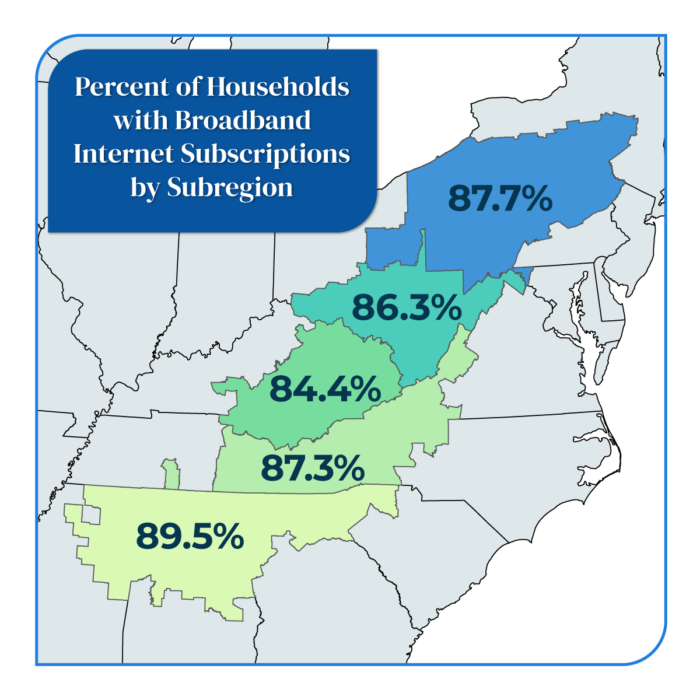
Broadband Subscriptions by Subregion
Broadband or high-speed Internet access helps people pursue learning, telework and more. During 2020-2024, 87.8% of Appalachian households had a broadband Internet subscription, compared to 91% nationwide. In 59 Appalachian counties, less than 80% of households had a broadband subscription.
Change in Broadband Subscriptions
Device Access in Appalachia
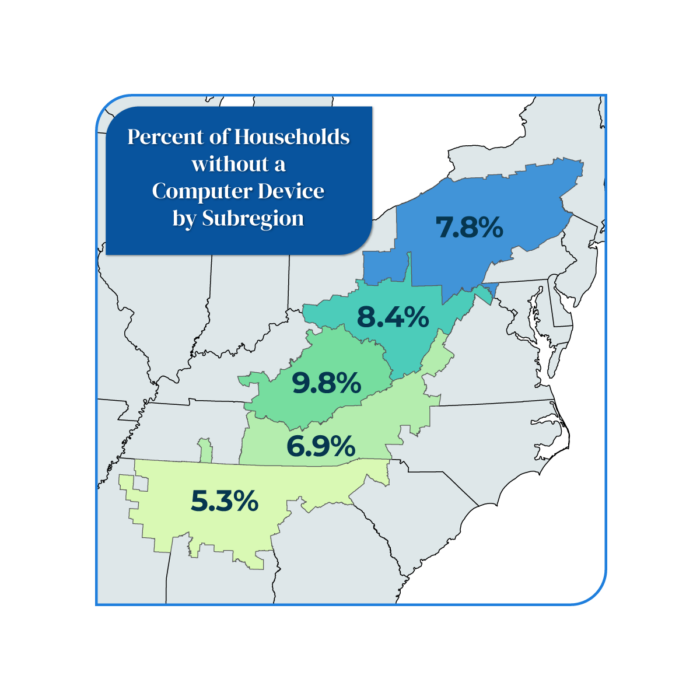
Households with No Device Access by Subregion
In the wake of COVID-19, the share of Appalachian households with at least one computer device increased by 6.9 percentage points – 1.7 points more than the U.S. rate – between 2015-2019 and 2020-2024.
Despite increasing to 93% of households with a computer device, Appalachia remains 2.5 points below the nation. Only 29 counties were at or above the national average; all but four were in metropolitan areas.
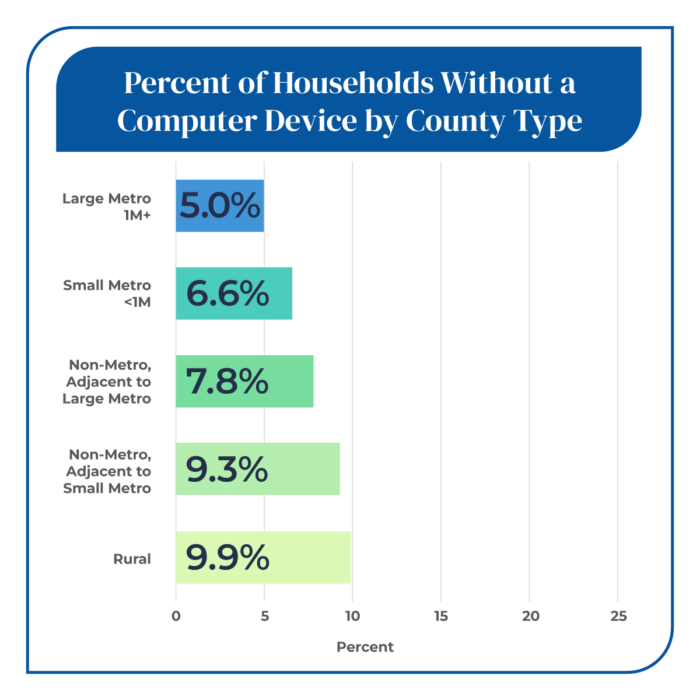
Households with No Device Access by County Type
The share of Appalachian households with a computer device was below 85% in 18 of Appalachia’s 423 counties. All of those counties were outside metropolitan areas, and nearly two in five were in Central Appalachia. This suggests a “digital divide”—particularly between urban and rural areas in Appalachia—that will likely be more apparent in coming years.