The Appalachian Region continues to see improvements in all levels of educational attainment. In 2024, the number of Appalachian adults ages 25 and over with at least a high school diploma has risen more than two percentage points to 89.5%, with the greatest improvement in adults ages 65 and over. The region’s high school completion prevalence is now almost equal to that of the country.
Appalachia continues to lead the nation in associate’s degrees, and the share of adults ages 25 and over in the region with at least a bachelor’s degree has risen to 28%. However, despite these increases, the prevalence of four-year college completion among adults remains well below the U.S. average in many parts of the region.
Learn more about education trends in Appalachia below.
Educational Attainment
89.5% of Appalachian adults ages 25 and over have earned at least a high school diploma, similar to the U.S. average of 89.6%. The region’s 2.3 percentage-point increase in 2020-2024 is likely due to the rising share of adults attaining a bachelor’s degree or more.
Meanwhile, the share of Appalachian adults ages 25 and over with an associate’s degree but no bachelor’s degree was 9.5% in 2020-2024 — 0.6 percentage points higher than in 2015-2019, exceeding the national average of 8.8%.
Similarly, the share of adults ages 25 and over in the region with at least a bachelor’s degree also rose by 3.6 percentage points since 2015-2019 and is now 28%, compared to the national average of 35.7%.
Change in Educational Attainment
Bachelor’s Degree
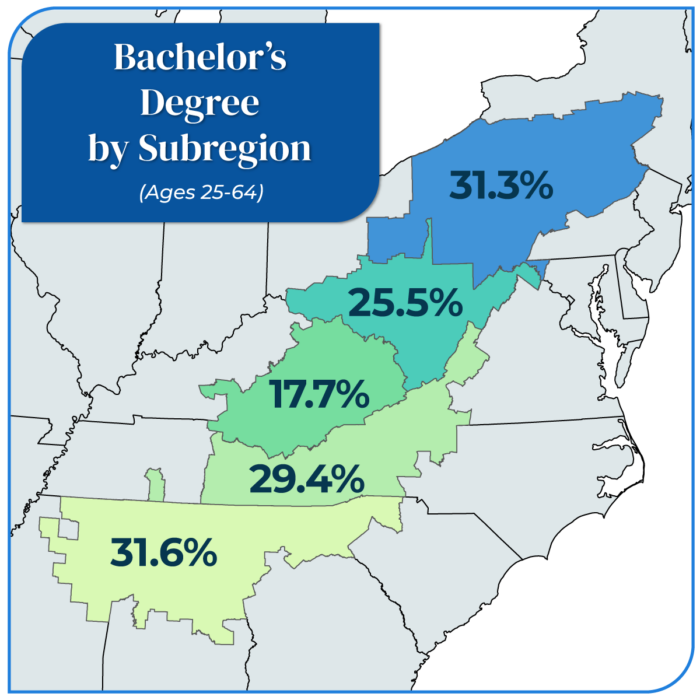
More than 29.5% of Appalachian adults ages 25-64 hold a bachelor’s degree. Though more people hold a bachelor’s now than in 2019, there are educational attainment differences in Appalachia’s subregions. Central Appalachia, for example, is 19.6 percentage points below the national average.
STEM Education